


Few figures in Indian history have left such a strong mark on the landscape, politics and cultural memory of western India as Chhatrapati Shivaji Maharaj. His name is often associated with dramatic battles, hill forts, daring escapes and the creation of Swarajya. But the story becomes more interesting when it moves beyond the battlefield. Shivaji Maharaj was not simply a military commander who captured forts. He built a political system, developed a network of strategically placed strongholds, used diplomacy alongside warfare and understood the importance of geography in controlling the Deccan. His career unfolded during a period when the Deccan was divided among powerful states, including the Adil Shahi Sultanate of Bijapur and the Mughal Empire. Against this complicated political background, Shivaji Maharaj gradually built an independent kingdom. The Maharashtra government's historical material describes his coronation at Raigad in June 1674 as a major assertion of sovereign kingship..
The Early Years at Shivneri

Shivaji Maharaj was born at Shivneri Fort, near present-day Junnar in Maharashtra, to Shahaji Bhonsle and Jijabai. His early life unfolded in a politically unstable Deccan. His father, Shahaji, was an influential military leader who served different Deccan powers during his career. Jijabai played an important role in Shivaji's upbringing and is remembered in historical traditions for influencing his understanding of religion, ethics and leadership. But the young Shivaji also grew up in a landscape that would later become central to his military strategy: the Sahyadri mountains. The region's narrow passes, steep hills, forests and numerous hill forts offered natural defensive advantages. Rather than attempting to control the entire Deccan at once, Shivaji Maharaj began building power around strategically important territories and forts..
The Idea of Swarajya
One of the most important ideas associated with Shivaji Maharaj is Swarajya, commonly understood as self-rule. The political environment of the 17th-century Deccan was complex. Mughal authority was expanding southward, while the Deccan Sultanates controlled substantial territories. Shivaji Maharaj's early campaigns gradually brought forts and territories under his control. The capture of Torna Fort is traditionally regarded as one of the important early steps in his rise. Maharashtra government material describes Torna as closely connected with the foundation of Swarajya and notes that its resources were used in developing Rajgad. Rajgad subsequently became the centre from which Shivaji Maharaj expanded and administered his growing kingdom. According to Maharashtra's Directorate of Information and Public Relations, Rajgad served as his capital for about 25 years before the capital was shifted to Raigad..
The Forts Were More Than Military Bases

When people think of Shivaji Maharaj's forts, it is easy to imagine them simply as defensive structures. Their role was much broader. Forts could function as administrative centres, storage locations, military bases, communication points and places of refuge.
Rajgad, for example, contained residential areas, water facilities, grain and ammunition stores and other infrastructure. Shivaji Maharaj also understood that control of a fort could mean control over the surrounding routes and valleys. This explains why the fort network became such an important part of Swarajya. By the time of his death in 1680, historical accounts cited by Maharashtra's archaeological researchers describe a large network of forts spread across areas of present-day Maharashtra, Karnataka, Tamil Nadu and Goa. Exact numbers vary according to the source and definition of what constituted a fort under his control..
The Battle With Afzal Khan

One of the most famous episodes in Shivaji Maharaj's life was his encounter with Afzal Khan, a senior commander of Bijapur. The meeting took place at Pratapgad in 1659 after Afzal Khan had been sent to confront Shivaji. The encounter ended with Afzal Khan's death and became a turning point in Shivaji Maharaj's struggle against Bijapur. The episode has been retold in many different forms over the centuries, with legendary elements becoming deeply embedded in popular memory. For a historical account, however, the larger significance is clear: the defeat of Afzal Khan strengthened Shivaji Maharaj's position and demonstrated that the growing Maratha force could challenge a major regional power..
The Attack on Shaista Khan

Shivaji Maharaj's conflict with the Mughals produced another famous episode. In 1663, he launched a surprise attack on Shaista Khan, the Mughal governor who was staying in Pune. The raid demonstrated a style of warfare that relied heavily on speed, intelligence, surprise and familiarity with local terrain. Shivaji Maharaj was not always interested in meeting a larger army in a conventional open battle. Instead, his forces often relied on mobility and sudden attacks. This approach later became strongly associated with Maratha military operations, although the broader history of Deccan warfare was more complicated than the modern shorthand of simply calling every such tactic "guerrilla warfare."
The Surat Campaign

In 1664, Shivaji Maharaj's forces attacked Surat, one of the wealthiest commercial centres of the Mughal Empire. Surat was a major port and trading city with connections to merchants and European trading companies. The campaign brought substantial wealth to Shivaji's state. It also demonstrated another feature of 17th-century warfare: economic resources were essential for maintaining armies, forts and administration. The Surat campaign remains controversial in historical discussions because of the violence and seizure of wealth associated with it. It should therefore be understood within the military and political context of the period rather than reduced to a simple heroic or villainous narrative..
The Treaty of Purandar
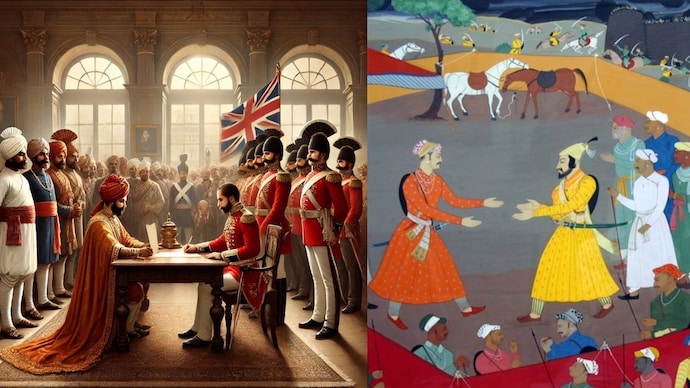
Shivaji Maharaj's rise did not consist only of victories.
In 1665, after Mughal pressure increased, he entered into the Treaty of Purandar with the Mughal commander Jai Singh.
Under the agreement, Shivaji surrendered a number of forts and accepted Mughal terms.
This was not the end of his political career.
Instead, the following years would produce one of the most remarkable episodes of his life.
The Agra Episode
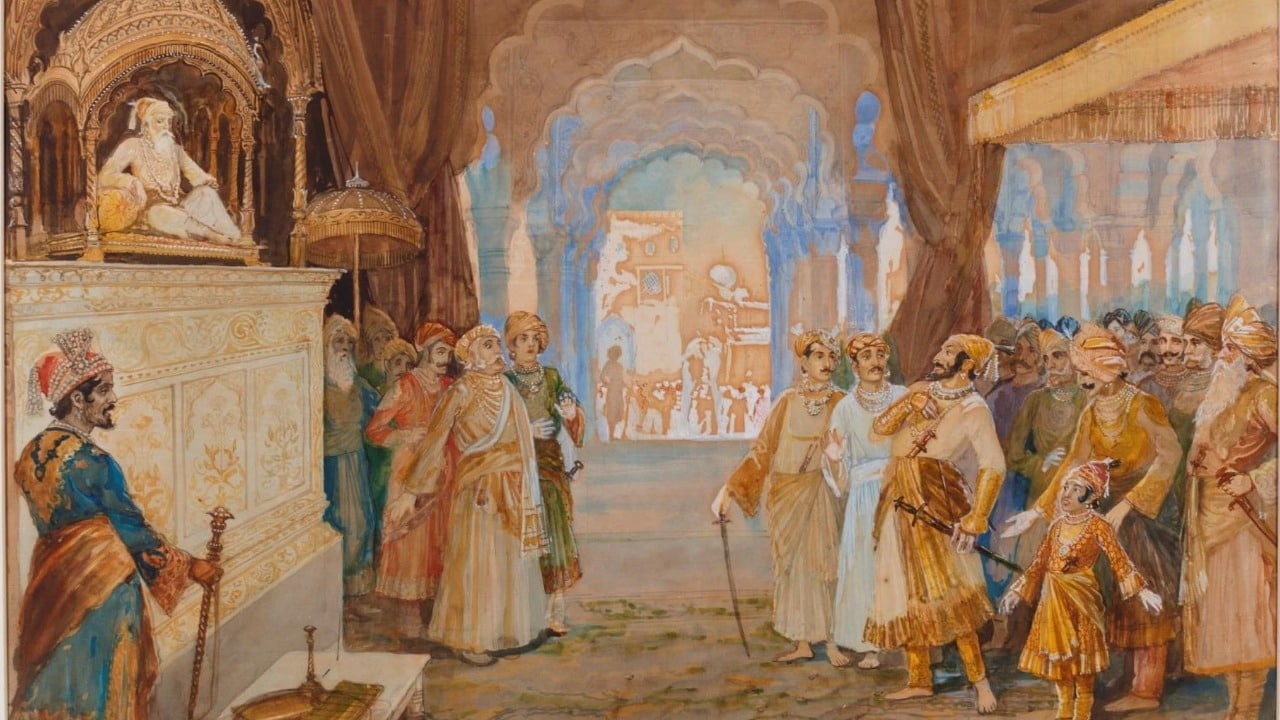
In 1666, Shivaji Maharaj travelled to the Mughal court at Agra to meet Emperor Aurangzeb. The visit did not go as expected. Accounts describe Shivaji becoming dissatisfied with his treatment at the Mughal court and subsequently being placed under restrictions. His escape from Agra has become one of the best-known stories in Maratha history. Popular retellings often focus on the dramatic details of the escape, including the famous fruit-basket story. Historians have debated the precise details of the episode, and later narratives sometimes contain elements that are difficult to independently verify. What is historically important is that Shivaji Maharaj successfully returned to the Deccan and rebuilt his political position..
The Return to Expansion
After returning from Agra, Shivaji Maharaj resumed his campaigns.. Maharashtra government historical material records that from 1670 onward he recovered many territories previously lost to the Mughals and expanded his control during the years leading up to his coronation.. This period demonstrated an important characteristic of his leadership.. A temporary political setback did not necessarily mean the collapse of his larger project.. Instead, Shivaji Maharaj used changing political circumstances to regain territory and strengthen his position..
Why Raigad Became So Important
Eventually, Raigad became the capital of Shivaji Maharaj's kingdom. The fort was not merely a military stronghold. It was developed as a functioning royal and administrative centre. Historical descriptions mention water systems, gateways, administrative buildings, residences and roads within the fort complex. Raigad also became the setting for one of the defining moments of Shivaji Maharaj's life. His coronation..
The Coronation of 1674
On 6 June 1674, Shivaji Maharaj was formally crowned at Raigad.
The coronation was more than a ceremonial event.
It represented the formal assertion of sovereignty and the transformation of Shivaji's growing political power into a recognised kingship.
Maharashtra's historical records describe the coronation as an important declaration that Shivaji was no longer simply a regional military leader or subordinate of another power, but a sovereign ruler.
The ceremony involved elaborate rituals and was followed by another coronation ceremony later in the year according to a different ritual tradition.
From this point, the title Chhatrapati became closely associated with Shivaji Maharaj.
The Administration Behind the Battles
One of the less discussed aspects of Shivaji Maharaj's legacy is his administrative system.
As his territories expanded, military victories alone were not enough.
The kingdom required taxation, officials, records, law enforcement, military organisation and systems for managing forts and resources.
The traditional account of his administration includes the Ashtapradhan, or council of eight ministers, with different officials responsible for areas such as finance, foreign affairs, military matters and justice.
The exact functioning of these offices changed over time, and historians continue to examine how closely later descriptions correspond to the administration during Shivaji's lifetime.
Nevertheless, the broader picture is clear: Shivaji Maharaj was building a functioning state rather than simply maintaining a collection of conquered territories.
His Approach to Revenue
Revenue was central to the survival of Swarajya.
Agriculture was the foundation of the economy, and effective collection of revenue was essential for maintaining the army and administration.
Shivaji's government attempted to bring greater organisation to land assessment and revenue collection.
The broader objective was to strengthen the state's financial base while reducing the dependence on uncontrolled extraction by local intermediaries.
This administrative dimension is important because it shows why the expansion of Swarajya could continue after individual military campaigns ended.
A Leader Who Understood the Sea
Shivaji Maharaj is often remembered primarily as a ruler of the mountains.
But he also recognised the strategic importance of the Arabian Sea.
He developed coastal forts and supported a naval force intended to protect the Konkan coast and challenge maritime threats.
Forts such as Sindhudurg became important components of this coastal strategy.
The Maratha military landscape later expanded into a much larger network of hill, coastal and island forts.
In 2025, UNESCO inscribed the Maratha Military Landscapes of India on the World Heritage List. The inscription includes 12 strategically important forts across Maharashtra and Tamil Nadu and recognises their architectural and military significance.
This UNESCO recognition provides a modern reminder of how important fort architecture was to the military system developed by the Marathas.
The Importance of Geography
Perhaps one of Shivaji Maharaj's most important strategic advantages was his understanding of geography.
The Sahyadris offered steep ridges, narrow passes and difficult terrain.
A large army unfamiliar with the region could struggle to move quickly through it.
Shivaji Maharaj's forces could use forts and mountain routes to move between defensive positions.
This did not make them invincible, nor did it mean that every battle was won through surprise.
But the combination of mobility, intelligence, fortifications and local knowledge gave the emerging state important advantages.
Shivaji Maharaj and Religious Policy
Shivaji Maharaj's relationship with religion is another subject that has been interpreted differently across historical traditions.
He was a deeply religious Hindu ruler, and the establishment of a sovereign Hindu kingship was an important part of the political symbolism of his coronation.
At the same time, historical accounts record interactions with people and institutions belonging to different religious communities.
His administration included Muslim officers and soldiers, and his military campaigns were fundamentally shaped by political and strategic considerations rather than by a simple religious binary.
This is one reason historians distinguish between the religious symbolism of Swarajya and the more complex realities of governing a diverse 17th-century society.
Women and Civilian Protection
Accounts of Shivaji Maharaj's rule also frequently highlight instructions concerning women and civilian populations during military campaigns.
However, individual stories about such orders vary in historical reliability, and some popular accounts were written or expanded long after the events.
It is therefore useful to distinguish between the broader reputation of discipline within his military system and specific anecdotes that cannot always be independently verified.
For a modern historical understanding, the principle is important: Shivaji's state needed to govern civilian populations, collect revenue and maintain legitimacy, not simply win battles.
Shivaji Maharaj Was Also a Diplomat
The popular image of Shivaji Maharaj can sometimes make him appear to have been permanently at war.
The historical record is more complicated.
He negotiated treaties, entered temporary alliances, exchanged correspondence with neighbouring powers and adapted his strategy when circumstances changed.
The Treaty of Purandar and the Agra visit are obvious examples.
Diplomacy was not separate from his military strategy. It was one of the tools through which he managed stronger opponents and bought time to consolidate his position.
The Southern Campaign
During the later part of his reign, Shivaji Maharaj expanded his activities into southern India. His campaigns reached areas of present-day Karnataka and Tamil Nadu. These expeditions helped extend Maratha influence and created additional strategic positions. Maharashtra government historical material notes that Shivaji's southern campaign included the construction and acquisition of forts in southern territories. The southern campaigns also demonstrated that Swarajya had evolved from a regional movement in the western Deccan into a larger political project..
His Final Years
Shivaji Maharaj spent his final years managing a kingdom that had become significantly larger and more complex than the territory he had controlled as a young leader.
He continued military and administrative activity while dealing with questions of succession and relations among members of the royal family and powerful nobles.
He died at Raigad in 1680.
His death did not end the political system he had created.
Instead, the Maratha state continued under his successors and eventually became a major power in the Indian subcontinent.
The Legacy of Chhatrapati Shivaji Maharaj
Shivaji Maharaj's historical importance cannot be explained by a single battle or one military tactic.
His legacy lies in the combination of several elements:-
State-building:- He transformed a regional political movement into a structured kingdom.
Fort strategy:- He developed and controlled a network of strategically important forts.
Military mobility:- He used terrain, speed, intelligence and flexible tactics.
Diplomacy:- He negotiated with powerful rivals when political circumstances demanded it.
Administration:- He developed institutions for governing territory rather than relying solely on military power.
Coastal strategy:- He recognised the importance of naval and coastal defence.
Sovereignty:- His 1674 coronation formalised his claim to independent kingship.
The Man Behind the Legend
Perhaps the most interesting way to understand Shivaji Maharaj is to look beyond the larger-than-life image created by centuries of storytelling. The historical Shivaji was a ruler operating in a difficult political environment. He faced stronger armies, negotiated when necessary, accepted temporary setbacks, rebuilt his position, developed forts and administrative institutions, and eventually established a sovereign kingdom. Some stories surrounding him have become legends, while others are supported by contemporary or near-contemporary records. Separating the two does not make his story less remarkable. In many ways, it makes it more fascinating. The rise of Shivaji Maharaj was not the result of one dramatic victory. It was the product of years of political calculation, military organisation, geography, diplomacy and state-building. That is the deeper story behind the rise of Swarajya.
Why Shivaji Maharaj Still Matters
Centuries after his death, the forts associated with his rule remain visible across the landscape of western and southern India. The UNESCO recognition of the Maratha Military Landscapes has brought renewed international attention to the architectural and strategic legacy of this period. But Shivaji Maharaj's legacy extends beyond stone walls and battlefields. His life illustrates how a regional power could emerge in a politically fragmented environment by combining military strength with administration, diplomacy and a clear idea of sovereignty. That combination — rather than any single battle or legend — is what makes the story of Chhatrapati Shivaji Maharaj one of the most important chapters in the history of early modern India..