


The debate over how much freedom children should have online has taken an important turn in India.
The Supreme Court has said that children have a fundamental right to access and use the internet, just like adults. The observation came while the Court was examining the larger problem of child sexual exploitation and abuse material circulating through social media platforms and other online services.
A bench of Justices J.B. Pardiwala and K. Vinod Chandran said the right to access and use the internet flows from Article 21 read with Article 19(1)(a) of the Constitution. The Court made the observation in an order passed on October 15.
But the judgment is not a free pass for unrestricted social-media use by children.
In fact, the Court's message is more nuanced: children's access to the digital world should be protected, while the digital environment around them must become safer.
Why Did the Supreme Court Take Up the Issue?

The case concerns the continuing circulation of child sexual exploitation and abuse material (CSEAM) online.
The Court was considering measures to make intermediaries and online platforms more effective in detecting, reporting and removing such material.
The issue became particularly important because one possible response to online risks is to simply keep children away from the internet or social media.
The Supreme Court rejected that approach as a blanket solution.
According to the Court, if harmful material exists because platforms and wrongdoers are failing in their responsibilities, restricting the victim's access to the internet does not address the real problem.
Children Also Have a Fundamental Right to Use the Internet
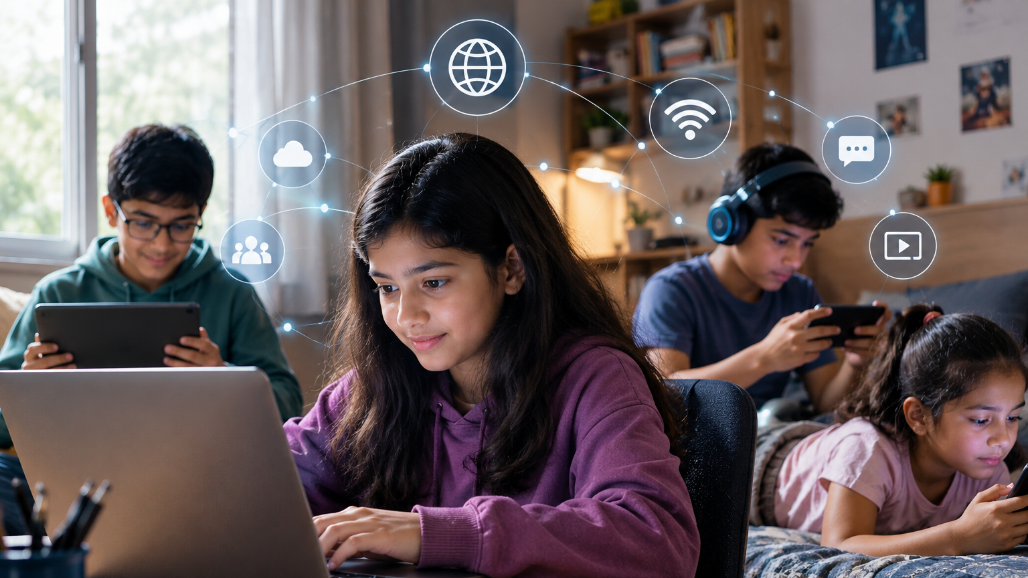
The Court's most significant observation was that internet access is a fundamental right for every individual, including children.
The reasoning is linked to constitutional protections under Article 21, which protects life and personal liberty, and Article 19(1)(a), which protects freedom of speech and expression.
The Court also recognised that freedom of expression is not limited to speaking or publishing. It includes the ability to receive information and ideas.
That makes internet access particularly important in today's world, where education, communication, information and creative expression increasingly take place online.
Why a Blanket Ban May Not Work

The Court acknowledged that the internet, in its current form, can expose children to serious risks.
These include online grooming, sexual exploitation, cyberbullying and harmful or age-inappropriate material.
But completely removing children from the internet may create a different set of problems.
The Court noted that children may simply move to other websites or platforms that are less regulated. It also expressed concern that children who are being groomed, threatened or exploited online could become reluctant to seek help if they fear punishment from parents or guardians for using the internet.
In other words, making the internet inaccessible does not necessarily make children safer.
The Court's approach instead places greater emphasis on making online platforms responsible for the environment they create and the content they allow to circulate.
Internet Access Is Also About Education and Information

The Court's reasoning goes beyond social media.
For many children, particularly those living in remote areas, the internet can be an important — and sometimes the only — source of education and information.
The Court also highlighted its importance for children with special needs, who may use online communities to find information, communication and companionship with others facing similar circumstances.
This is an important distinction.
Internet access is not the same thing as unrestricted access to every website or every type of content.
A child may need the internet for homework, educational videos, communication or accessibility tools without necessarily needing unrestricted access to every social-media feature.
So Does the Supreme Court Oppose Restrictions on Children?
No.
This is one of the most important points to understand.
The Court rejected blanket denial of internet access, but it did not say that children should have completely unrestricted online access.
Instead, the judgment leaves room for proportionate safeguards designed specifically to protect children.
Among the measures discussed by the Court are parental consent and oversight, child-specific settings and a dedicated "child mode" for social-media accounts.
The Court also indicated that children's accounts could potentially be private by default, contact and messages from unknown adults could be restricted, and advertisements and other content could be moderated.
What Could "Child Mode" Mean?
The idea of a child mode is particularly significant because it moves the discussion away from a simple question of whether children should be online.
Instead, the focus becomes how children should experience the internet.
A child-specific mode could potentially include:
- Private accounts by default
- Restrictions on messages from unknown adults
- Stronger content filters
- Greater parental oversight
- Reduced exposure to targeted advertising
- Additional safeguards against inappropriate content
- Age-appropriate recommendations
- Easier reporting mechanisms
The precise framework and implementation, however, would require further action by the government and platforms. The Court left the modalities of several such safeguards to the Union Government.
What Does the Judgment Mean for Social Media Platforms?
The ruling puts greater attention on the responsibilities of online intermediaries.
The Court has directed stronger mechanisms for dealing with child sexual exploitation and abuse material.
It has also called for easier reporting and grievance-redressal systems. Platforms are expected to make grievance officers' details clearly available and allow complaints to be submitted without unnecessary difficulty.
The Court said trained grievance officers should take final decisions on complaints, while automated systems can assist with preliminary screening.
This is significant because online child safety cannot depend entirely on parents monitoring every message, search and interaction.
Platforms themselves control many aspects of the digital environment — from recommendation systems to reporting tools and content moderation.
The Court Wants Action Against the Problem, Not the Child

Perhaps the strongest message from the judgment is that responsibility should not simply be shifted onto children.
If an adult creates, circulates or seeks illegal material, the person responsible must be dealt with.
If a platform fails to comply with its legal responsibilities, that failure must also be addressed.
Keeping children away from the internet because others are misusing it, the Court reasoned, risks putting the burden on the very people who need protection.
This changes the framing of the debate.
The question is no longer simply:
"Should children be allowed online?"
It increasingly becomes:
"How can children be allowed online without exposing them to preventable harm?"
Schools May Also Have a Bigger Role

The Supreme Court has also called for stronger digital-safety education.
The Court directed that digital safety and age-appropriate sex education should form part of the core curriculum, with the curriculum to be developed by NCERT and SCERTs in consultation with experts.
Children should learn about consent, safe and unsafe touch, online exploitation and how to report abuse without fear of punishment.
This could make digital safety education a more formal part of children's learning rather than leaving the responsibility entirely to individual families.
The Court also called for teacher training and awareness programmes for parents.
What Does This Mean for Parents?
For parents, the judgment does not mean that they should stop setting boundaries.
Quite the opposite.
The Court's approach suggests that guidance and supervision are more useful than simply treating the internet as something children should never use.
Parents can focus on practical measures such as:
1. Talk about online safety:
Children should know that they can approach a trusted adult if someone online makes them uncomfortable or threatens them.
2. Use privacy controls:
Parents should understand the privacy and safety settings available on the platforms their children use.
3. Keep communication open:
A child who fears losing internet access may hesitate to report a problem. Open communication can make it easier for children to ask for help.
4. Teach children not to share sensitive information:
Personal photographs, addresses, school details, passwords and other sensitive information should be handled carefully.
5. Explain online grooming:
Children should understand that strangers online may deliberately build trust before attempting to manipulate or exploit them.
6. Report harmful behaviour:
Parents and children should know how to report suspicious accounts, messages or content.
The goal should be safer internet use, not simply less internet use.
What About the Government?
The Supreme Court has left several policy questions for the Union Government.
These include how parental consent should work, how child-specific social-media safeguards should be designed and how age-related protections can be implemented without creating excessive surveillance or misuse of personal data.
The issue is complicated because age verification itself can require platforms to collect or process sensitive information.
The Court has therefore recognised that child protection measures must also respect privacy and proportionality.
The Court's Earlier Digital Rights Jurisprudence

The latest observation also builds on earlier Supreme Court decisions concerning digital access.
In Anuradha Bhasin v. Union of India (2020), the Court recognised that freedom of speech and expression and the freedom to carry on trade or business through the internet are constitutionally protected rights.
The Court had stopped short at that time of directly declaring internet access itself to be a fundamental right.
The position developed further in the Pragya Prasun case in 2025, where the Court recognised digital access as a fundamental right under Article 21.
The 2026 ruling takes the issue further by expressly recognising the right to access and use the internet as a fundamental right, including for children.
Why This Matters Beyond Social Media

The judgment is important because the internet is no longer simply a place for entertainment.
Children use it for:
- School and education
- Research and information
- Communication
- Creative expression
- Accessibility tools
- Online communities
- Learning new skills
- Accessing government and public information
That means a blanket ban could have consequences beyond social-media use.
The challenge is to distinguish between digital access as a fundamental freedom and access to specific online services or content that may be inappropriate or harmful for children.
The Court's reasoning leaves space for that distinction.