


India’s 5 New UNESCO Tentative List Sites: Ancient Caves, Temples and Forts You Should Know About
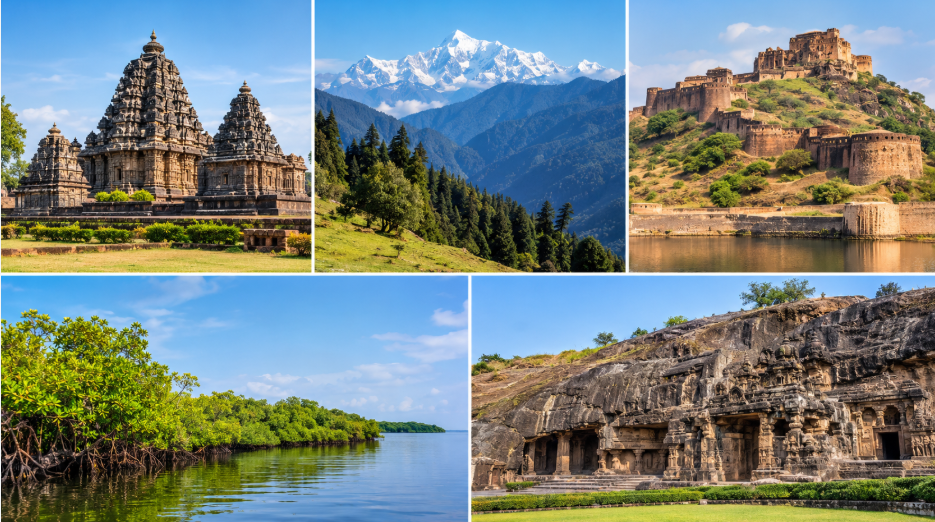
India has never really needed an introduction when it comes to history and heritage. From ancient cave paintings to magnificent temples, old forts and historic cities, almost every part of the country has a story waiting to be discovered. Now, five more places have received international attention after being added to India's UNESCO World Heritage Tentative List in 2026. What makes the update particularly interesting is that four of the five new entries are from Madhya Pradesh, while the fifth comes from Assam. The additions include ancient caves, temple complexes, a historic fort and a remarkable cultural landscape. But there is an important distinction to understand: being on UNESCO's Tentative List does not mean that a site has already become a UNESCO World Heritage Site. A Tentative List is essentially an inventory of places a country intends to consider for future nomination to the World Heritage List.
Still, inclusion is significant because it puts these lesser-known heritage treasures into the spotlight.
Let's take a closer look..
1. Bagh Cave Paintings — Madhya Pradesh
Hidden among the rocky landscape of Madhya Pradesh are the Bagh Caves, known especially for their remarkable ancient paintings. The caves are associated with Buddhist traditions and are an important example of India's rock-cut heritage and early mural art. Unlike the huge tourist crowds found at some of India's better-known heritage attractions, places like Bagh offer something different: a quieter encounter with history. The paintings and remains give visitors a glimpse into the artistic and cultural world of centuries ago. For anyone interested in ancient Indian art, architecture or history, Bagh is a fascinating destination to keep on the travel radar.
UNESCO added “Bagh Cave paintings” to India's Tentative List with a submission date of July 8, 2026..
2. Ginnorgarh Fort — Madhya Pradesh
The second new Madhya Pradesh entry is Ginnorgarh Fort. Forts across India often tell stories of changing kingdoms, battles, rulers and local cultures. Ginnorgarh adds another chapter to that long history. The fort sits in a landscape that combines natural surroundings with historic architecture, making it interesting not only for history enthusiasts but also for travellers who enjoy exploring places away from conventional tourist routes. Its addition to the UNESCO Tentative List could help bring greater attention to this relatively lesser-known historic site.
UNESCO records Ginnorgarh Fort as a new Indian Tentative List entry dated July 8, 2026..
3. Group of Temples of the Chambal Valley — Madhya Pradesh
The Chambal region is often associated with its dramatic ravines and river landscape.
But there is another side to the region—its architectural heritage.
The newly listed Group of Temples of the Chambal Valley brings together three important historic sites:
- Bateshwar
- Padavali
- Kakarmath
Together, these monuments represent the architectural and cultural heritage of the Chambal Valley. The inclusion is particularly interesting for travellers because it highlights a part of Madhya Pradesh that can sometimes be overshadowed by better-known destinations.
For those who enjoy temple architecture, ancient sculpture and offbeat travel, the Chambal Valley deserves a closer look. UNESCO added this group to India's Tentative List on July 8, 2026.
4. Udaigiri Caves — Madhya Pradesh
The fourth new Madhya Pradesh entry is the Udaigiri Caves.
These ancient rock-cut caves near Vidisha are particularly important for understanding India's early religious art, architecture and history. The site contains caves, sculptures and inscriptions associated with the Gupta period, one of the most influential periods in the development of classical Indian art and culture. Walking through a historic cave complex like Udaigiri can feel very different from reading about ancient India in a textbook. The stone itself becomes part of the story.
UNESCO's Tentative List records Udaigiri Caves as a new entry dated July 8, 2026.
Interestingly, Udaigiri is also connected to broader discussions about Gupta-period heritage. UNESCO's Tentative List includes a separate serial nomination concerning Gupta temples in North India, which includes Cave No. 1 at Udayagiri..
5. Rangpur-Sivasagar Historic Ensemble — Assam
The fifth addition takes us from central India to the northeast. The Rangpur-Sivasagar Historic Ensemble in Assam represents an important chapter of the region's historical and cultural heritage. Sivasagar is closely associated with the Ahom kingdom and its architectural legacy. The area is known for historic monuments, tanks and structures that reflect the power and cultural identity of the Ahom period. For travellers exploring Assam, Sivasagar offers something beyond the state's famous natural attractions. It is a place where history, architecture and local culture come together. UNESCO records the Rangpur-Sivasagar Historic Ensemble as an Indian Tentative List entry dated June 19, 2026..
Why Is the UNESCO Tentative List Important?
You might wonder why these places are being called “UNESCO sites” when they have not yet been declared World Heritage Sites. That's an important distinction. A Tentative List is the starting point in the World Heritage nomination process. UNESCO describes it as an inventory of properties that a country intends to consider for nomination. So, being added to the list does not guarantee World Heritage status. However, it can give a heritage site greater visibility and encourage more attention toward its preservation, documentation and responsible tourism.
In other words, these five places are not yet new UNESCO World Heritage Sites—but they are now part of India's official pool of places being considered for future nomination..
Why Madhya Pradesh Stands Out
Four of the five recent additions are from Madhya Pradesh. That should not come as a huge surprise to anyone familiar with the state's history. Madhya Pradesh has an extraordinary concentration of archaeological and cultural heritage, including ancient Buddhist sites, rock-cut architecture, temples, forts and historic cities. The state already has internationally recognized heritage attractions such as Khajuraho, Sanchi and Bhimbetka, while several other places remain on the Tentative List. UNESCO's current records include a wide range of Madhya Pradesh properties and proposed heritage nominations. The latest additions show that the state's heritage story extends far beyond the destinations most tourists already know..
A New Reason to Explore Lesser-Known India
One of the most exciting things about heritage tourism is discovering places before they become crowded. A UNESCO-related announcement can make travellers curious about destinations they may never have heard of before. Bagh, Ginnorgarh, the Chambal Valley and Udaigiri are good examples. They remind us that India's history isn't limited to a handful of famous monuments.
Sometimes, the most interesting travel experiences come from taking a slightly different road, visiting a lesser-known archaeological site and hearing the local stories connected to it..
Heritage Tourism Should Also Be Responsible Tourism
Greater attention can bring more visitors—and that can be good for local economies.
But heritage tourism also comes with responsibility. Ancient paintings, sculptures, temples and historic structures cannot simply be treated like ordinary tourist attractions. Visitors should follow site rules, avoid touching or damaging monuments, respect local communities and choose responsible travel practices. The goal should not simply be to collect photographs.
It should be to experience these places while helping ensure that they remain there for future generations..
What This Means for Travellers
If you are planning a heritage-focused trip around India, these five additions are worth keeping on your list.
Madhya Pradesh
Bagh Cave Paintings — Ancient art and rock-cut heritage
Ginnorgarh Fort — Historic fort architecture and landscape
Bateshwar, Padavali & Kakarmath — Temple architecture of the Chambal Valley
Udaigiri Caves — Ancient caves, sculptures and Gupta-period heritage
Assam
Rangpur-Sivasagar Historic Ensemble — Ahom-era history and architecture
These aren't simply destinations for people interested in history.
They can also appeal to photographers, architecture lovers, culture enthusiasts, students and travellers looking for experiences beyond India's standard tourist circuit..
The Bigger Picture
India currently has a large number of properties on its UNESCO Tentative List, reflecting the country's enormous cultural and natural diversity. UNESCO's latest records list dozens of Indian properties under consideration.
The five 2026 additions are therefore part of a much bigger story.
They remind us that India's heritage is constantly being documented and brought into wider public awareness.
And perhaps that's the most interesting part.
A monument doesn't become valuable simply because an international organization recognizes it. These places already carried centuries of history before they appeared on a UNESCO list.
The new recognition simply gives more people a reason to look closer..
Final Takeaway
Five more Indian heritage entries have joined UNESCO's Tentative List in 2026, including four remarkable places in Madhya Pradesh and the Rangpur-Sivasagar Historic Ensemble in Assam.
They represent different sides of India's past—from ancient cave paintings and rock-cut caves to temples, forts and historic cultural landscapes.
They may not yet carry UNESCO World Heritage status, but for travellers and history lovers, that doesn't make them any less fascinating.
Sometimes the best travel discovery is not the place everyone is already talking about.
It's the place you discover just before everyone else does.
Note: Inclusion on UNESCO's Tentative List is not the same as inscription on the UNESCO World Heritage List. Future World Heritage status would require the subsequent nomination and evaluation process.